

Halloween-y Bugs: What NOT to Eat on Halloween...
Some bugs look a little spooky. Some people might argue that all bugs look spooky. Either way, I’m in the mood for some Halloween, and, based on their orange and black appearance, so are large milkweed bugs!
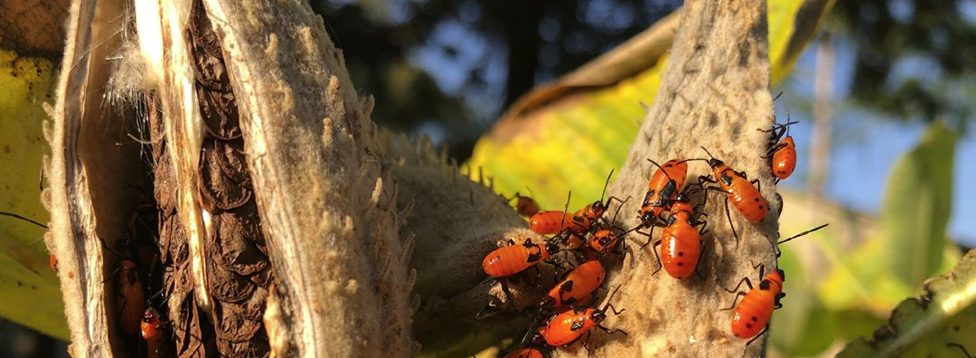
Large milkweed bugs
Monarch caterpillars aren’t the only game in town when it comes to milkweed (Asclepias). Several different kinds of bugs rely on milkweed: small milkweed bugs, red milkweed beetles, milkweed tussock moth caterpillars, and a few others. Oh, and large milkweed bugs.
Large milkweed bugs, Oncopeltus fasciatus, are technically true bugs. ‘True bugs’ is a term used by entomologists to describe a group of insects (some 50,000 to 80,000 species!) that have piercing and sucking mouthparts. They cannot chew but rather insert their beak into a plant and suck the plant sap. Other examples include aphids, leafhoppers, and cicadas. Their young nymphs somewhat resemble their adult phase, which means they do not undergo a complete metamorphosis (like a caterpillar creates a chrysalis and emerges a beautiful butterfly).
Large milkweed bugs fit that description to a ‘T.’ They feed on sap from seeds, leaves, and stems of milkweed. Milkweeds are rarely killed from them; they are more of a nuisance than anything. One interesting aspect about these insects is that they migrate. A researcher first documented this activity on populations from Iowa. Towards the end of the summer when the days began to shorten, temperatures cooled, and milkweeds started to decline, large milkweed bugs were found to high tail it out of Iowa in search of warmer digs. Turns out, they travel all the way to the southern Atlantic area and Gulf Coast states, and then reverse their flight the next spring/summer to head back north. Some populations exist in southern regions year-round that do not migrate and stay put.
But are they spooky? One thing is certain: you shouldn’t eat them. Only a few insects can eat milkweeds. This is because they produce toxins, called cardiac glycosides, that are poisonous to humans, pets, livestock, and the vast majority of insects. In humans, these toxins can cause bloating, fever, and difficulty breathing, among other symptoms, and results can be fatal if enough milkweed is consumed. Well, it turns out that a handful of insects are able to store the cardiac glycosides, rather than metabolize them. This is exactly what large milkweed bugs (and monarchs for that matter) do. When a predator eats one, it will vomit and never eat another one again. And they advertise their unsavoriness with their Halloween-y bright orange and contrasting black colors.
So, while the jury is still out on whether large milkweed bugs are spooky, everyone can agree they are quite festive! …and don’t eat them!
Dr. Jill Calabro
Research & Science Director
Horticultural Research Institute
Share This Post