

Lose the (Azalea) Lace Bugs
Cherry blossoms hog the flowering plant spotlight every spring in the D.C. area, but there’s another woody out there that deserves equal (if not more) attention: azaleas. And one of the best places to see them in all their glory is at the U.S. National Arboretum (USNA). Fun fact: National Geographic readers recently named the USNA as one of the ten best destinations for blooms in the world! Their azalea collection is part of the reason why. Every spring, over 10,000 azaleas stun visitors with gorgeous pink, purple, coral, and white blooms. In fact, these beautiful blooms first prompted the USNA to open to the public 70 years ago, and yes, they are that beautiful!

Photo courtesy Dr. Jill Calabro
But every rose has its thorn. And in the case of azaleas, that thorn is azalea lace bug.
Azalea lace bug is one of the most common pests on azaleas and can be devastating. Early infestations are discreet and may go unnoticed until the damage becomes severe. If you start seeing azalea leaves that look like they are covered in tiny white-to-yellow colored dots or leaves that look unusually yellow with green veins, azalea lace bug may be the culprit, and it’s time to act. Repeated infestations can result in plant death.

Photo via Facebook, Friends of the National Arboretum (@FONArboretum)
These little bugs are inconspicuous, covertly waging warfare against azaleas. They prefer the undersides of leaves and are small; so, they are not obvious. Plus, larvae are nearly translucent and wingless, making them even harder to detect. They feed in clusters, sucking sap from the plant and draining it of nutrients and chlorophyll. Adults are no more than ¼” in length with translucent, lace-like wings (hence the name). It overwinters as black eggs on leaf undersides often found along leaf veins. After hatching in spring, this pest completes its life cycle in about 40 days. This means there can be as many as 4 generations per year in some locations – maybe even five in southern states.
If infestations persist, the plant will suffer over time and become increasingly susceptible to other pests, diseases, and weather extremes. Premature leaf drop may occur, and small shrubs are at a greater risk for death.
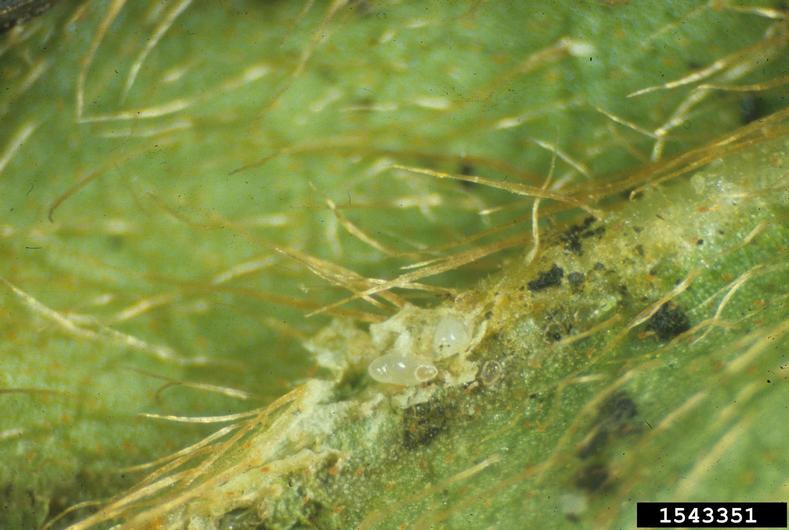
Jim Baker, North Carolina State University, Bugwood.org
Many control options are available. Before planting, consider the site. Azaleas grown in sunny locations tend to be more susceptible to lace bug problems. Cultivars range in terms of their tolerance of lace bug. For example, several selections in the Encore series are considered resistant (Autumn Amethyst, Autumn Sangria, Autumn Rouge and others), while others are considered moderately resistant (Autumn Embers, Autumn Bravo, Autumn Ruby, and others).
Natural enemies do exist, such as minute pirate bugs, jumping spiders, and lace wings (oh my!). But in many situations, pesticide use is warranted. Insecticidal soaps, contacts (such as pyrethroids – just make sure to apply to leaf undersides), and systemics (such as neonicotinoids and acephate) have been shown effective. As with most pest problems, insecticides will prevent and reduce new damage, but they will not instantly make current damage disappear. Plants will need to outgrow damaged foliage, and this takes time.
Be monitoring now, as azalea lace bug eggs are surely hatching!
And next time you’re in the D.C. area, please make some time to visit the USNA!
Dr. Jill Calabro
Research & Science Director, HRI & AmericanHort
Share This Post