

New Research Tackles Rose Rosette, Black Spot Diseases
Horticultural Research Institute (HRI) is delighted to share news of a brand-new, multi-year, multi-million dollar grant for research tackling rose diseases.
The industry suffers nearly $10 million in annual losses due to the two most damaging rose diseases: rose rosette disease (RRD) and black spot. Fortunately, a group of 21 researchers from around the country led by Dr. David Byrne and Dr. Oscar Riera-Lizarazu at Texas A&M have received $4M through the USDA NIFA’s Specialty Crop Research Initiative (SCRI) to develop adapted and commercially acceptable rose rosette resistant varieties.
The project combines traditional plant breeding, field evaluations, and molecular genetics to develop sustainable landscapes based on cultivars resistant to rose rosette and black spot diseases. The project will also seek best practices for managing the diseases through a series of multistate trails assessing chemical and cultural controls. Finally, project economists will evaluate the management options for socio-economic impacts and provide decision support information for the industry and home gardeners.
HRI participates on the advisory board for this project and will assist in the project team’s outreach and educational efforts.
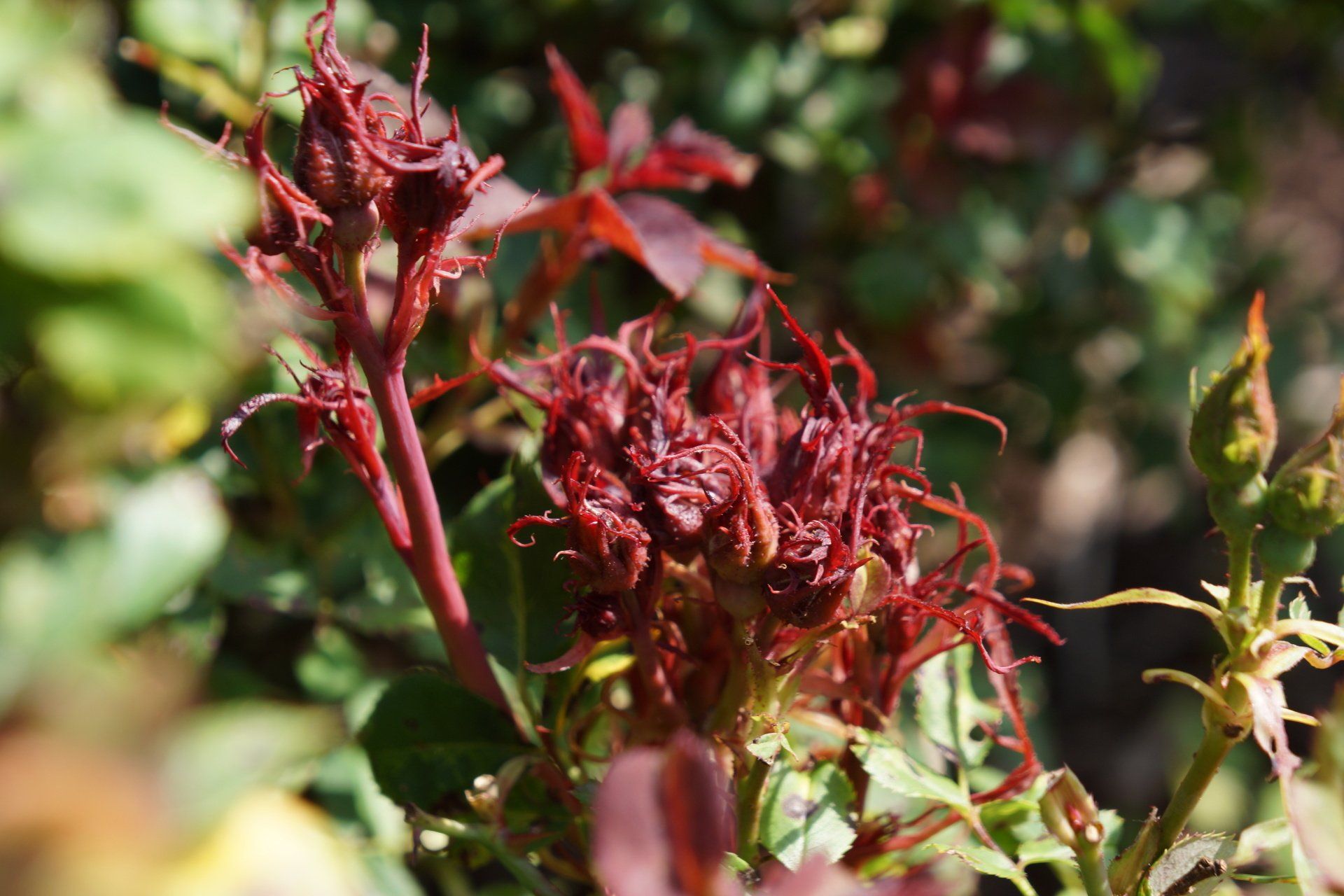
Image Caption: Typical symptoms of RRD are known and widely accepted; they include rapid elongation of new shoots, witches’ brooms, small or distorted leaves, red pigmentation of stems or foliage, and excessive thorn development.
Learn more about the Sustainable Rose SCRI project in this article issued by Texas A&M University.
Texas A&M AgriLife to lead disease-resistance project to save rose industry
A new rose cultivar might smell sweet, but will it resist disease? Texas A&M AgriLife is leading a team of researchers to ensure the answer is “yes” to alleviate the estimated $10 million in annual disease-related loss to the rose industry.
“The goal of our latest project is to meet the increasing demand for carefree and sustainable roses that require fewer inputs, are resistant to biotic and abiotic stresses, and have high ornamental quality,” said David Byrne, Ph.D.
Byrne, the Basye Chair in Rose Genetics, is co-leading the new project with Oscar Riera-Lizarazu, Ph.D., both Texas A&M AgriLife Research rose geneticists in the Texas A&M Department of Horticultural Sciences in the College of Agriculture and Life Sciences.
Their new project, “Developing Sustainable Rose Landscapes via Rose Rosette Disease Education, Socioeconomic Assessments, and Breeding RRD-Resistant Roses with Stable Black Spot Resistance,” received $4 million in funding from the U.S. Department of Agriculture Specialty Crop Research Initiative.
Resistance necessary to rose rosette, black spot diseases
Rose rosette disease, caused by the rose rosette virus, is a significant threat to cultivation and production throughout the U.S. Black spot disease is the major fungal disease of field-grown roses throughout the world.
These are the two most damaging rose diseases, and resistance to both is essential in a sustainable cultivar,” Byrne said.
Approximately 35% of garden roses sold are used by the professional landscape market. Recently, this sector has decreased its use of roses by about 10% each year due to rose rosette disease, according to the Census of Horticulture Specialties.
Currently, most cultivated roses are susceptible to these diseases, Byrne said, and thus the transport and distribution of infected asymptomatic plants propagates the disease spread. Already, plantings have been devastated in the Midwest and Eastern seaboard and major landscape firms are stopping the use of roses in some regions.
“We are concerned rose rosette disease has the potential to devastate the major rose production regions on the West Coast, Arizona and Florida if it is spread to those regions,” he said.
The project’s long-term goal is to develop sustainable landscapes based on cultivars resistant to rose rosette and black spot diseases.
This involves combining traditional plant breeding, with field evaluation sites in Texas, Tennessee and Oklahoma, with molecular genetics to accelerate the process of stacking multiple copies of multiple resistance genes into a rose. This approach should at least double the rate of progress, reducing the time it takes to develop highly disease-resistant, sustainable plants for gardens, Byrne said.
In collaboration with industry partners and hundreds of citizen scientists, Extension programs in Texas, Georgia, Tennessee and Ohio will monitor rose rosette disease’s geographic distribution. In multi-state trials, these collaborators will determine the best practices for managing the diseases, including chemical and cultural control methods as well as disease-resistant germplasm.
As the management options are developed, the economics specialists on the team will assess the socio-economic impacts of the various management practices to provide decision support for the industry and gardeners.
“These sustainable best management practices will reduce human and environmental exposure to agrochemicals and will be designed to avoid the introduction of the disease into regions that currently do not have it and to manage its severity in infested regions,” Byrne said.
An extensive network of private and public stakeholders, including breeding programs, production and wholesale/retail nurseries, landscapers, consumers, rose enthusiasts, public gardens, major rose testing organizations and industry publishers, have committed to work with the Extension team to disseminate the information.
“We believe this widespread education will lead to better management and lower costs for the industry and longer-lived plants that deliver enhanced enjoyment and consumer satisfaction,” Byrne said.
The ultimate goal is the restoration of healthy rose collections to botanical gardens, public parks and private landscapes to improve the aesthetics, thus resulting in improved wellbeing and property values.
Nationwide effort in place
The multi-state team consists of 21 researchers from Texas A&M; the University of Minnesota; the University of Tennessee; USDA-Agricultural Research Service, Beltsville, Maryland; the University of Tulsa; Oklahoma State University; the University of Georgia at Athens and Tifton; The Ohio State University; and the University of Wisconsin, River Falls.
In addition to Byrne and Riera-Lizarazu of the Rose Breeding and Genetics Program, the Texas A&M AgriLife team consists of Charlie Hall, Ph.D., Ellison Chair in Floriculture, and Patricia Klein, Ph.D., professor and executive associate dean for the College of Agriculture and Life Sciences, both in the Department of Horticultural Sciences; Kevin Ong, Ph.D., plant pathologist and director of the Texas Plant Disease Diagnostic Laboratory, and Jeanmarie Verchot, Ph.D., plant virologist, both in the Department of Plant Pathology and Microbiology; Luis Ribera, Ph.D., Texas A&M AgriLife Extension Service economist and director of Texas A&M’s Center for North American Studies; and Marco Palma, Ph.D., professor in the Department of Agricultural Economics. All the Texas A&M AgriLife team members are based in Bryan-College Station.
Share This Post