

Box Tree Moth: Coming Soon to a Boxwood Near You?

HRI Research • April 3, 2020

A new insect pest, box tree moth, will likely make itself known to the U.S. soon after being found in a few Toronto area landscapes in fall 2018. An online, citizen science group first reported the sightings after a homeowner submitted photos of the pest that were then verified by an entomologist. This marks the first reports of this pest in North America; however, the findings remain unconfirmed by Canadian Food Inspection Agency (CFIA).

How did it get to Canada?

Our story begins in Germany, in the vicinity of a shipping center that receives materials from China. That’s where box tree moth (BTM) was first found in the EU in 2007. The details of BTM introduction to Germany are unknown, but it is most likely linked to importation of infested boxwoods from BTM’s native range, China. Since 2007, it quickly spread to nearly all countries in the EU, mostly through the movement of infested boxwood in the nursery trade; this is the likely explanation of how it made its way to Canada as well.

Not even a polar vortex can slow it down.
No natural predators exist in the EU. Not even birds and other animals will eat the caterpillars, because they contain toxins deemed distasteful. Once introduced to an area, damage to boxwood is severe. In just a few years, large areas of native boxwood trees and forests have been devastated. Between 2009 and 2010, German officials attributed over 90% defoliation in the country’s largest box tree forest to BTM. Boxwood can survive defoliation as long as the caterpillars do not eat bark on the main stems. Once this happens, boxwood lose ability to obtain necessary nutrients and water, while becoming more susceptible to fungal and bacterial infections.
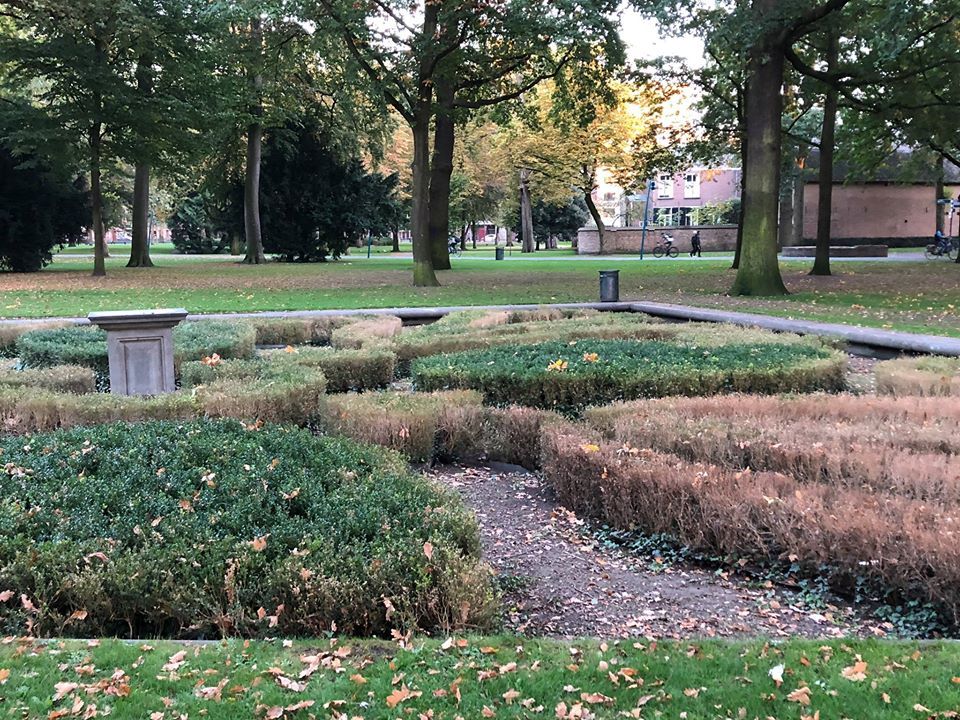
Boxwood garden destroyed by box tree moth. Photo courtesy Bennett Saunders.

Getting to Know BTM

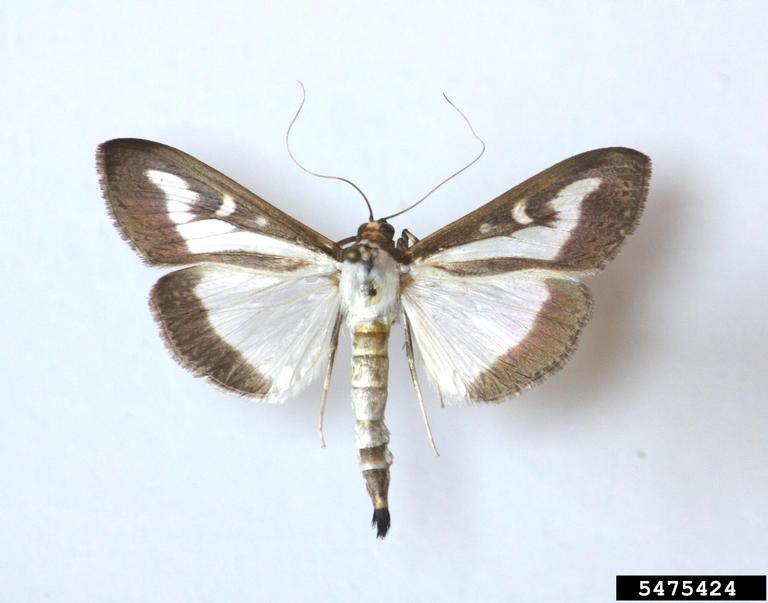
As with many insect pests, the most destructive life stage is larvae, or caterpillars in this case. Damage is caused by larvae feeding on leaves (aesthetic damage) and bark (physiological damage). Infestations are flagged by skeletonized leaves, frass deposits, and webbing created by caterpillars for protection during feeding and pupation. Adults are moths with a wingspan of about 1.5 inches, and wings are either white with a dark brown border or brown with small, white spots.
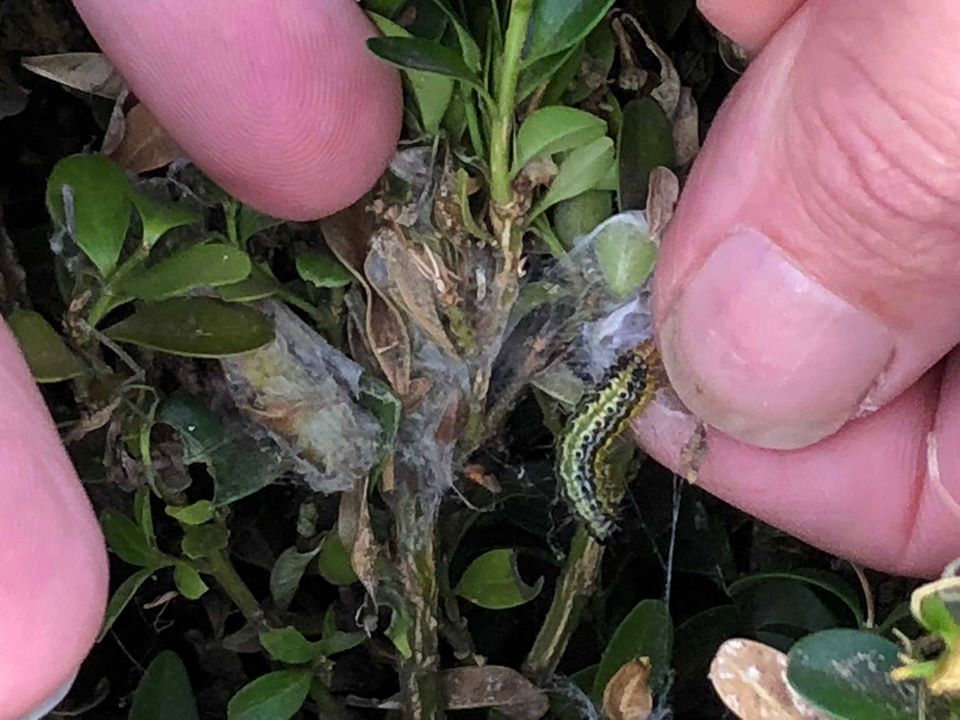
Box tree larvae and webbing. Photo courtesy Bennett Saunders.

The ideal temperature range for BTM is from 70 – 92° F, but activities are known to occur outside this range. Eggs hatch when temperatures are at least 52° F, and larvae regularly survive winter temperatures below -22° F in parts of China. Not even a polar vortex can slow it down. Depending on temperature and light levels, two to four life cycles per year are common in the EU; each lasts around 45 days.What can we do to protect ourselves?

APHIS has been closely monitoring for the potential introduction of this new pest to the U.S. for over ten years and created new pest response guidelines in preparation. One possible course of action that APHIS could take involves creating a federal order requiring inspection and certification of boxwood entering the U.S. from Canada.

Traps and monitoring programs are other examples. Researchers are unsure how quickly BTM will spread in the U.S. Box tree forests do not exist here; so, less host material may translate to slower or less spread.

Controls are available, including pheromone traps, pyrethroids, chlorantraniliprole, and Bacillus thuringiensis (Bt) products (Xentari, DiPel). Eradication in North America could be a viable option in North America, but only if we, as an industry, are vigilant and stay prepared for any suspicious-looking boxwood damage. Please report anything that even remotely looks like it could be BTM and help protect our boxwoods!
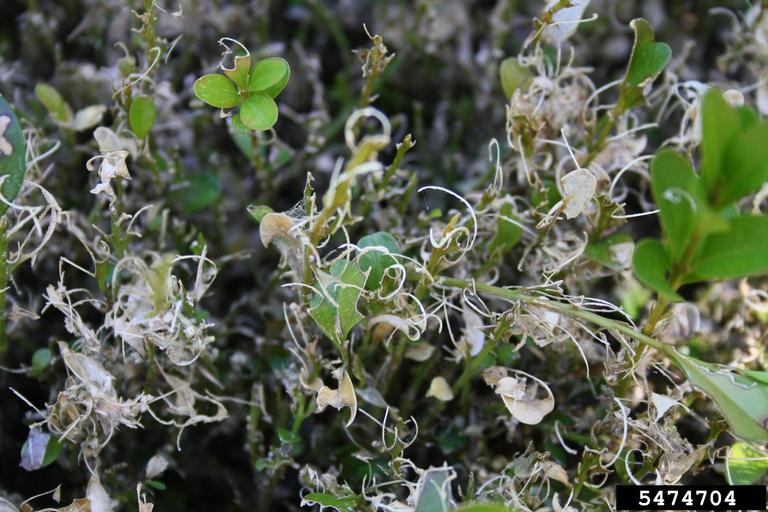
Damage to boxwood from box tree moth. Photo courtesy Ferenc Lakatos.

The Horticultural Research Institute (HRI) continues to monitor BTM as part of its ongoing Boxwood Initiative. Outreach on emerging pests and diseases is another example of how HRI helps the industry stay informed on issues impacting their bottom line.

Product information is in no way a product endorsement. Please consult product registration and label for the most current use information.

Dr. Jill Calabro
Horticultural Research Institute & AmericanHor

Learn more about HRI’s Boxwood Initiative here.

Share This Post

Blurry green foliage filling the frame
By Jennifer Gray May 28, 2026
Soilless Substrate Science (S3) is a national transdisciplinary collaboration developed to support growers as we advance to the next generation of substrates. Our team is leading North American efforts to develop new substrate materials and techniques, and working with growers to support implementation, as we support the global transition to substrates that go Beyond Peat. In this webinar, Dr. Jeb Fields will discuss the S3 team efforts surrounding identification of new substrate materials, processing and development, and grower support. We will explore wood fiber processing, sugarcane bagasse substrate development, stabilization of organic fibers, databasing substrate materials, and opportunities for growers to get involved. Overall, attendees will learn about US efforts to develop domestically-sourced substrates and advance substrate science as we move towards the next generation of substrate science. Our Speaker Dr. Jeb Fields is a production horticulturist who works with growers in Florida and throughout the country to support more effective and efficient production practices through his environmental nursery research program. Jeb’s primary interests include growing media & substrate science, irrigation & fertilizer management, whole plant-water relations and plant abiotic stress physiology. Jeb is an internationally recognized substrate scientist, the leader of the Beyond Peat project through the USDA Specialty Crops Research Initiative, and the national S3 (Soilless Substrate Science) team which pursues advancements of the global substrate industry and development sustainable substrate materials and practices, including substrate stratification. Jeb is the editor for Nursery & Landscape Insider, a biweekly e-newsletter from Ball Publishing, that reaches over 32,000 stakeholders worldwide. For his efforts, he has been recognized with numerous awards, honors, and leadership positions. Prior to joining UF, Jeb was a professor and research station director with the LSU AgCenter. Jeb studied at UF for his B.S., NC State University for his M.S., and Virginia Tech for his Ph.D. – with all degrees focusing on production horticulture.
A soft-focus background of varying shades of green, suggesting grass, foliage, or a forest landscape.
By Jennifer Gray April 9, 2026
This webinar dives into the problem of rose rosette virus. Shrub roses consist of multiple canes attached to a root system and produce beautiful spring growth in the form of new flowering stems and branches. Experts will provide an overview of how rose rosette virus first attacks flowering growth and can move throughout the stem. At the same time rosette symptoms appear in mature distinct stems of a plant and may be absent from others. The research delves into understanding how the vascular system connects the flowering stems and above ground canes. The research is to understand how virus movement between adjacent stems and only appears to cause disease in a few but not all canes of the same plant. This research is important to explore potential management approaches to safeguard rose.
By Jennifer Gray March 24, 2026
The horticulture industry continues to change as new technologies, production practices, and consumer expectations reshape the marketplace. Research plays an essential role in helping growers, landscapers, and retailers adapt and succeed. That’s exactly where the Horticultural Research Institute (HRI) enters the chat. Every year, HRI selects and funds research projects that advance horticulture. In 2026, HRI is investing more than $560,000 in 18 research projects that target challenges across the horticultural supply chain, including plant production, pest and disease management, landscape plant performance, and consumer insights. “What makes HRI research so valuable is that it focuses on real challenges the industry is facing right now,” said Mark Yelanich, HRI President and Research Director at Metrolina Greenhouses. “The 2026 HRI-funded projects were selected because they develop knowledge, processes, or tools that businesses can actually use.” HRI’s four strategic research priorities guide funding decisions, focusing on quantifying plant benefits, creating innovative solutions, gathering consumer insights, and producing practical solutions to industry challenges. The 2026 projects reflect these priorities across the horticulture supply chain.
Show More