

Stop and Smell the...Taphrina?
Fungi are just plain neat. It boggles my mind that one group of organisms can be so diverse. From mushrooms to dead man’s fingers to the causal agent of boxwood blight – they’re all fungi of one sort or another! One individual fungus can even look different depending on its life stage. For example, some rust diseases require two separate hosts to complete their life cycle (remember cedar apple rust?) and look completely different on each host. I can’t imagine how mycologists figured out it was the same fungus on both cedar and apple trees – and that was way before the advent of molecular techniques!
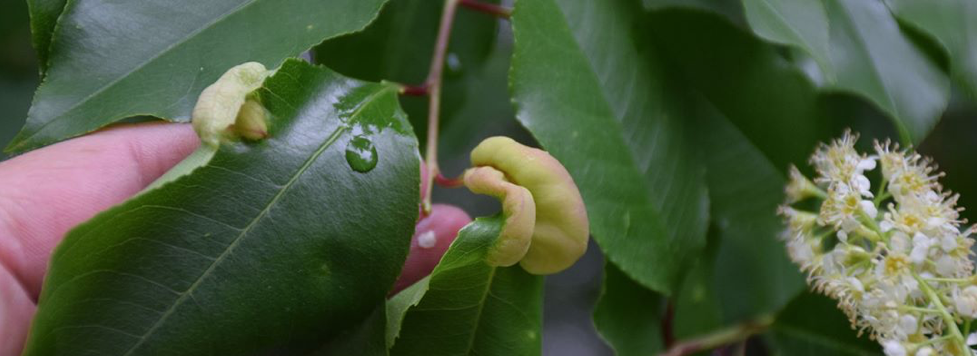
And then there’s Taphrina. No, it doesn’t have an odor, as the title implies.
You know that feeling when you run across something awesome you haven’t thought about in a long, long time but never really forgot it? That happened to me over the weekend.
I first learned about Taphrina leaf curl in my introductory plant pathology class at Iowa State and looked for it (unsuccessfully) for years; I’m talking decades. So imagine my excitement when I found some while out on a run a few days ago. Of course I went back with my camera to grab some photos and then decided to search for any updated information. And was late to brunch – but it was worth it!
So what is it? Taphrina is fungus that causes peach leaf curl, oak leaf blister, plum pockets, and a variety of other similarly named disease that convey the symptoms perfectly: thickened, curled, and/or puckered leaves, often with a reddish color. At least eighteen different species are known and are host specific. One of the most common, peach leaf curl, is caused by T. deformans, oak leaf blister is caused by T. caerulescens, and leaf curl on chokecherry (as in the picture) is caused by T. wiesneri. Other hosts include poplar, birch, maple, pear, apricot, and many others.
This disease is similar to rust diseases in that it looks different at different growth stages; however, it only uses one host to complete its life cycle. The first growth stage is very yeast-like in appearance. It overwinters in that yeast-like phase in bark crevices, bud scales, and infected tissue. In this phase, it can grow saprophytically, or without causing disease, for quite some time until conditions are prime for disease. Once the yeast-form comes in contact with host tissue during ideal environmental conditions, it’s on. Infection begins. A lot of plant pathogens can do this - hang out for a while on plant material, incognito, all sneaky-like, and then BAM! A switch goes off and all the sudden it’s a full on siege…kinda like a Trojan horse scenario.
In the case of Taphrina, infection happens early in the spring as leaves emerge and expand, while temperatures are cool (50 – 70 F) and conditions wet. Symptoms aren’t usually visible until after about two weeks. Exactly how Taphrina causes that typical leaf curling and puckering remains to be determined. The prevailing thought maintains that the fungus can influence and/or synthesize plant hormones, stimulating plant cells to grow larger than normal. Imagine if that was your superpower! After infection, leaves eventually turn brown and fall off the tree.
An argument can probably be made that maybe plant diseases make me a little too happy. At least this one is not too terribly injurious to its tree host; most of the damage is cosmetic, because of the leaf drop. However, the second leaf flush does weaken the tree. Preventive fungicide applications are only recommended in situations where leaf drop cannot be tolerated, such as nursery settings, but must be applied prior to bud break or right at leaf flush. Don’t worry about picking up the infected leaves once they fall. Spores have already been released and are likely lodged in bark fissures/crevices, and the yeast-like phase will start all over again…leading to more beautiful, puckered leaves next spring!
Dr. Jill Calabro
HRI & AmericanHort
Research & Science Programs Director
Share This Post