

Hazard Trees & The Notorious BIG Fungus
IT’S BEEN A RAINY SPRING IN THE MID-ATLANTIC. NORMALLY, THE SPRING RAINS MAKE ME LOOK FORWARD TO AN ALMOST CERTAIN FLUSH OF MUSHROOMS AND DISEASES. THE SPRING RAINS THIS YEAR, HOWEVER, HAVE BEEN ON THE EXCESSIVE SIDE AT TIMES, MAKING ME THINK OF A NOT SO FUN OUTCOME: HAZARD TREES.
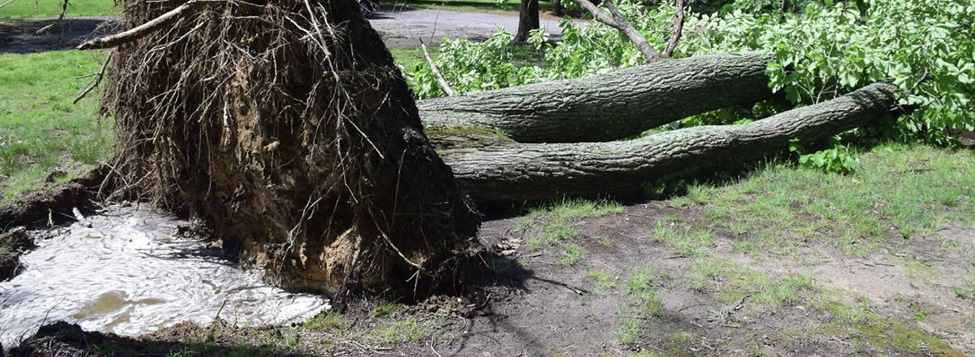
Specifically, my neighbor’s 90+-year-old swamp chestnut oak was uprooted during a thunderstorm. Aside from a temporarily blocked driveway, thankfully no one was hurt.
Foresters have their own vocabulary and “hazard tree” is one their terms. (So is “butt rot”, but more on that in a later post.) A hazard tree is a tree with a defect that poses a danger to people or property. For example, a tree heavily infested with emerald ash borer (think 70-90% defoliation) in a suburban yard, qualifies as a hazard tree. It likely has dead or dying limbs that could fall on a parked car, a house, or even a young child walking home from school on the sidewalk.
Hazard trees pose the greatest risk during ice or windstorms, heavy snow, and excessive rains, when the tree is stressed by outside forces. The majority of trees that ‘snap’ or topple during a storm (hurricanes and tornadoes aside) have some sort of hazard or defect that created a weak point. Most often a fungal plant pathogen is to blame.
Most scary is that sometimes the “hazard” is not overtly obvious, like my neighbor’s fallen tree. There was no stem canker, no conks, no nothing. This particular tree suffered from root rot, most likely caused by a species of Armillaria, which is a pretty unique fungus. Some species of Armillaria bioluminesce – yes, they glow in the dark! Not only that, but Armillaria mellea produces a mushroom revered as a delicacy, called the honey mushroom.
Notorious BIG Fungus
But don’t be fooled by Armillaria’s more appealing idiosyncrasies – this is one fungus not to play with. It’s downright notorious. Armillaria species are the most damaging and broadly distributed forest tree pathogens worldwide. Even more impressive, it’s the largest living organism in the world, covering 2,385 acres of the Malheur National Forest in Oregon. This is a very widespread, destructive, and slow-moving disease.
Fungi are often mysterious, inconspicuous, and in the case of Armillaria (and other root rots), subversive. External symptoms of root rots are subtle, such as low vigor, slow growth, and yellowing foliage, but they all lead to certain death. They prefer already stressed trees. Trees planted too deeply, subjected to a lengthened drought period, or infested with other pests are often more susceptible to Armillaria infection. After talking with a local arborist, I learned that many oaks in my local area are declining due to Armillaria, following a drought period in Maryland several years ago.
Unfortunately, control of Armillaria is next to impossible. Fungicides are ineffective, due to the nature of the disease. Research at Clemson has shown promise in a method where soil is excavated from the tree crown, allowing the crown and upper roots to be exposed to air and solarization. However, this is a labor-intensive process that may not be feasible in many situations, including my neighbor’s remaining oaks.
Guaranteed my neighbor (and I) will be closely monitoring the other oaks on property…and waiting patiently for the coming crop of honey mushrooms!
Dr. Jill Calabro
Horticultural Research Institute & AmericanHort
Share This Post