

Attack of the Giant Hogweed
Two of my friends (one is a weed scientist, the other an entomologist) and I have a running debate: we argue over which is most interesting – weeds, bugs, or fungi. If I could ever bring myself to consider that weeds might be cooler than fungi, giant hogweed would be a contender.
A little over a month ago, researchers from Virginia Tech announced that giant hogweed, a truly wicked invasive weed, had been confirmed for the first time in Virginia. As much as I like to dramatize the diabolicalness of various fungal diseases, this plant just scares the bejeezus out of me. The name alone is frightening - remember Hogzilla?!?!
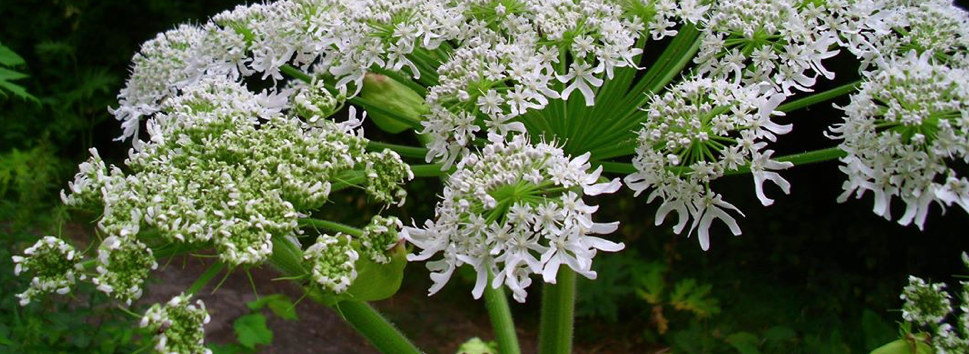
Giant hogweed is a member of the parsley or carrot family, Apiaceae, and, as its name implies, it gets big - 15 to 20 feet tall in fact. True to the plant family, its flowers are umbels (or umbrella-like), and even they are huge – up to 2.5 feet in diameter! It is also a biennial, meaning it requires two years to complete its life cycle, and no self-respecting invasive weed would be complete without being a prolific seed-producer and having a massive root system. Eradication is difficult, to say the least.
This dastardly weed prefers to grow in wet areas along streams and disturbed areas and is commonly found near houses and vacant lots. It quickly displaces any native or desirable plants and diminishes the environment. For example, native riparian plant species cannot compete, and eventually stream banks erode away. If you find some, don’t try to remove it yourself; call the professionals. This weed has one nasty trick up its sleeve (errr, stem): the sap can cause second and third degree skin burns and blindness if it gets in your eye.
Once the sap gets on your skin, it causes severe sunburn-like symptoms – one that’s bad enough to blister. Once certain compounds in the sap, called furocoumarins, get on skin, they are energized by UV light and then readily bind to DNA and cell membranes. This process doesn’t happen overnight but eventually destroys cells and skin tissue in a matter of days. What a defense mechanism!
Interestingly enough, long ago some creative doctors devised a treatment for psoriasis that is nearly identical to the process described above: a furocoumarin-like drug is combined with UVA radiation. However, this treatment reportedly can lead to skin cancer.
A couple of other members of the parsley family cause similar effects, including wild parsnip and cow parsnip. These bad actors are a fraction of the size of giant hogweed; however, and only grow 4-7 feet tall.
Giant hogweed can be found in about a dozen US states and parts of Canada, including the Pacific Northwest, the Northeast, the upper Midwest, and parts of the Mid-Atlantic. It’s native to Caucasus Region and was first documented in the US in 1917. The dried fruit is prized as a spice in the Middle East.
So, yeah, giant hogweed is a pretty neat weed…but still not as awesome as the fungus that turns ants into zombies. Fungi totally rule.
It’s worth mentioning again: if you think you have found some, please contact your local extension agent or other professional for assistance – don’t tackle this one on your own!
Dr. Jill Calabro
HRI Research Director
Image via Creative Commons. “Image made by nature protector Natubico; www.vivism.info.”
Share This Post